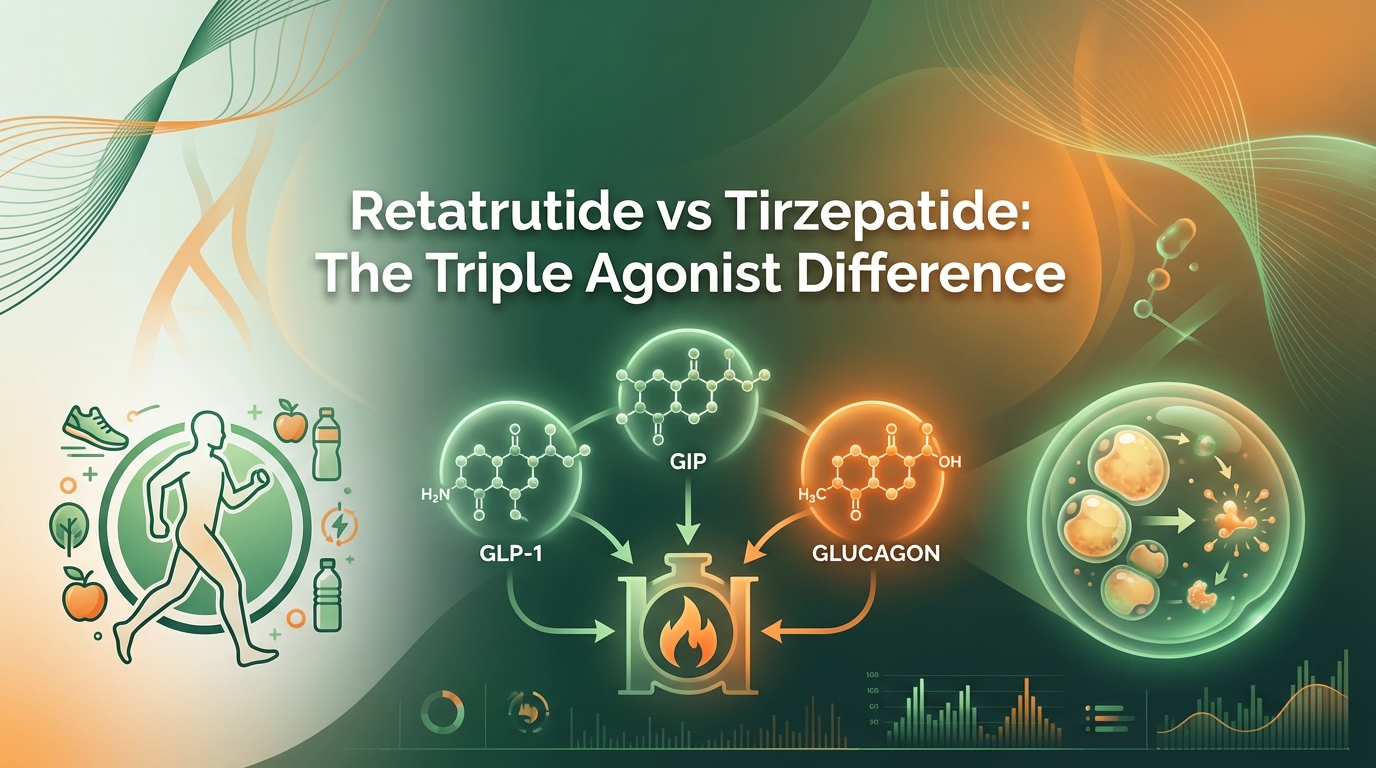
Retatrutide vs Tirzepatide: The Triple Agonist Difference
Table of Contents
Retatrutide vs Tirzepatide: The Metabolic Difference That Actually Matters
The weight loss peptide landscape shifted in 2023 when Eli Lilly's Phase 2 trial data revealed something unexpected: participants taking the highest dose of Retatrutide lost an average of 24.2% of their body weight in 48 weeks, surpassing even Tirzepatide's impressive 20.9% benchmark. Yet the real story isn't about superior weight loss numbers. It's about what happens inside the body when a third receptor—Glucagon—enters the equation, changing how cells burn fat rather than just reducing how much food enters the system.
For patients who've already experienced the appetite suppression of GLP-1 medications or the dual benefits of Tirzepatide, the question isn't whether Retatrutide works better. It's whether the mechanism that makes it more effective also makes it more appropriate for specific metabolic conditions—or potentially riskier for others. The addition of Glucagon receptor activation doesn't just intensify existing effects; it introduces an entirely different metabolic pathway involving energy expenditure, hepatic fat clearance, and mitochondrial function. This creates distinct advantages for certain patient profiles while raising legitimate questions about cardiovascular stress and long-term safety signals observed in trial data.
This analysis moves beyond the surface-level "triple agonist beats dual agonist" narrative. It examines the biochemical trade-offs between these medications, explores why Retatrutide shows particular promise for fatty liver disease, and identifies which patients might be better candidates for the metabolic "furnace" of Retatrutide versus the regulatory precision of Tirzepatide.
Understanding the Triple-Agonist Mechanism: Why Adding Glucagon Changes Everything
Tirzepatide works through two pathways—GLP-1 and GIP—that primarily regulate insulin secretion and suppress appetite. Patients feel fuller faster and eat less. The weight loss comes from caloric restriction, with metabolic rate remaining largely unchanged. Retatrutide adds a third component: the glucagon receptor. This addition changes how the body burns energy at rest.
The glucagon receptor activates hepatic lipid oxidation, breaking down fat stores in the liver and converting them to energy. This process increases thermogenesis—the body's internal heat production—raising resting metabolic rate by approximately 5-8% in trials. Think of it as the difference between eating less food versus burning more fuel. Tirzepatide optimizes the intake side of the equation. Retatrutide modifies both intake and expenditure.
This mechanism has specific implications for body composition. GLP-1-only therapies like semaglutide show concerning lean mass loss—up to 40% of total weight lost comes from muscle tissue. Tirzepatide improves this ratio slightly through its GIP activity, which appears to have muscle-protective effects. Early data suggests Retatrutide preserves lean mass even more effectively, with preliminary reports showing improved lean mass retention relative to total weight lost compared to historic GLP-1 data.
The glucagon component also accelerates hepatic glucose production and fatty acid oxidation simultaneously—a metabolic state that doesn't naturally occur in typical caloric restriction. This creates what researchers call "forced catabolism," where the liver must process stored triglycerides even in fed states. For patients with metabolic dysfunction-associated steatotic liver disease (MASLD, formerly NAFLD), this represents a distinct therapeutic advantage over dual agonists. The liver essentially becomes unable to maintain pathological fat storage under sustained glucagon receptor activation.
The Liver-First Advantage: Retatrutide's Impact on Metabolic Dysfunction-Associated Steatotic Liver Disease
Approximately 30% of adults in Western populations have excess liver fat, with prevalence climbing to 55-60% among obese adults. This condition—now termed MASLD—drives insulin resistance, increases cardiovascular risk, and can progress to cirrhosis. Traditional weight loss medications address liver fat as a secondary outcome. Retatrutide appears to target it directly.
In the 48-week Phase 2 trial, patients receiving the highest dose (12 mg) showed an average liver fat reduction of 81.4% measured by MRI-PDFF, the gold standard for hepatic fat quantification. This exceeds the reductions seen with tirzepatide at comparable timepoints. What's more, 86% of Retatrutide participants achieved the clinical threshold for MASLD resolution—defined as liver fat content below 5%. Tirzepatide studies show resolution rates of 62-74% in similar populations, depending on dose and trial duration.
The mechanism explains the difference. Glucagon receptor activation directly stimulates hepatic mitochondrial beta-oxidation—the biochemical process that breaks down fatty acids inside liver cells. This occurs independently of weight loss. Some participants showed significant liver fat reduction before substantial weight changes, suggesting a direct hepatic effect rather than just a consequence of caloric deficit.
This matters for treatment sequencing. A patient with BMI 32 and confirmed MASLD might benefit more from Retatrutide as first-line therapy, while someone with BMI 38 and normal liver function might achieve their goals with Tirzepatide's better-established safety profile. The choice becomes phenotype-specific rather than simply choosing "the newest option."
The liver improvements also correlate with metabolic markers. Participants showed average reductions in ALT and AST—liver enzymes indicating cellular damage—of 35-40% from baseline. Triglycerides dropped by an average of 48%, significantly more than the 30-35% reductions typically seen with dual agonists.
Comparing Clinical Outcomes: The 24% vs. 21% Question and What the Numbers Actually Mean
Headlines focus on peak weight loss percentages: 24.2% for Retatrutide versus 20.9% for Tirzepatide. These figures mislead without context. The trials used different durations, populations, and titration schedules. Direct comparison requires understanding what happened at equivalent timepoints and doses.
At 48 weeks—the longest shared timepoint between major trials—Retatrutide 12 mg produced mean weight loss of 24.2% in treatment-naive patients. Tirzepatide 15 mg achieved 20.9% at 72 weeks in the SURMOUNT-1 trial, with approximately 17-18% loss at 48 weeks. The gap narrows to roughly 6-7 percentage points when properly aligned. Still significant, but not the 15-20% leap that marketing materials imply.
Response rates tell a more nuanced story. In Retatrutide trials, 91% of participants lost at least 5% body weight, and 75% achieved 15% or greater loss. Tirzepatide showed 89% and 63% respectively for these thresholds. The difference emerges most clearly in extreme responders: 27% of Retatrutide patients lost 30% or more body weight compared to 15% on Tirzepatide.
Plateau patterns differ between compounds. Tirzepatide participants typically reach maximum weight loss between weeks 60-72, with curves flattening considerably after week 48. Retatrutide's Phase 2 data ended at week 48, leaving open questions about whether weight loss continues, stabilizes, or reverses during potential months 12-18 of treatment. The glucagon-driven metabolic rate increase theoretically prevents the adaptive thermogenesis that causes plateaus, but longer studies will determine if this holds true.
Glycemic control showed comparable improvements. Both medications reduced HbA1c by 1.8-2.0% in diabetics. Fasting glucose declined similarly. The glucagon component didn't create hyperglycemia as older glucagon-based therapies did—likely because the GLP-1 activity counterbalances glucagon's glucose-raising effects while preserving its fat-burning benefits.
The Glucagon Receptor: Why "Burning More" Isn't the Same as "Eating Less"
Tirzepatide suppresses appetite through two coordinated pathways. GLP-1 slows gastric emptying. GIP enhances insulin sensitivity and amplifies satiety signaling in the hypothalamus. The result? A patient who simply wants less food. This is metabolic optimization—the body runs on fewer calories and adjusts accordingly.
Retatrutide does all of that. Then it adds something different.
The glucagon receptor component doesn't reduce intake. It increases output. Glucagon activates hepatic lipid oxidation, essentially instructing liver mitochondria to pull fatty acids from storage and convert them into usable energy. This isn't a subtle distinction. It's the difference between dimming the lights in a room and installing a second furnace in the basement. Total energy expenditure rises independent of caloric restriction.
Phase 2 trial data showed that participants on Retatrutide's highest dose (12 mg) experienced measurable increases in energy expenditure compared to placebo—a signal largely absent in Tirzepatide trials at comparable timepoints. This matters for patients who've plateaued on dual-agonist therapy. Their bodies have already adapted to reduced intake. Metabolic adaptation—the decline in basal metabolic rate that accompanies sustained caloric deficit—is the primary reason weight loss stalls on any GLP-1 drug. Glucagon receptor activation directly counteracts that adaptation.
But here's what most comparisons miss: this thermogenic effect is dose-dependent and tissue-specific. At lower doses (4 mg), Retatrutide's glucagon activity is modest. The weight loss curve at that dose closely mirrors Tirzepatide's, suggesting the GLP-1/GIP components do the heavy lifting early on. The glucagon "furnace" only becomes the dominant differentiator at 8 mg and above. This has real clinical implications. A patient titrating slowly may not experience the metabolic acceleration that headlines promise until months into treatment.
The practical takeaway? Retatrutide doesn't just make people less hungry. It changes the thermodynamic equation itself. For someone whose metabolism has downregulated after months on Tirzepatide or semaglutide, that distinction could be the difference between a 15% and a 24% total body weight reduction.
Retatrutide and the Liver: A Case for Metabolic Triage in MASLD
Tirzepatide improves liver fat. That much is established. The SURMOUNT trials documented reductions in hepatic steatosis markers, and the drug's insulin-sensitizing effects through GIP receptor activity reduce de novo lipogenesis—the liver's tendency to manufacture new fat from excess carbohydrates. For many patients with mild fatty liver, this is enough.
It's not enough for everyone.
Metabolic dysfunction-associated steatotic liver disease (MASLD, formerly NAFLD) exists on a spectrum. At the severe end sits steatohepatitis with fibrosis—a condition where the liver isn't just storing fat but actively inflaming and scarring. Reducing fat production helps. But clearing fat already deposited in hepatocytes requires a different mechanism: direct lipid catabolism.
This is where Retatrutide's glucagon receptor action becomes genuinely significant. Glucagon stimulates beta-oxidation of intrahepatic triglycerides. In simpler terms, it tells liver cells to break down and burn their own fat stores. Phase 2 data demonstrated that participants receiving Retatrutide 12 mg showed a reduction in liver fat content of approximately 82% from baseline at 48 weeks, with a substantial proportion achieving complete normalization of liver fat (below 5%). Tirzepatide hasn't shown comparable hepatic fat clearance rates at similar timepoints in published data, though direct head-to-head liver-specific trials haven't been conducted.
The clinical relevance extends beyond imaging results. Excess intrahepatic fat drives systemic insulin resistance, elevates cardiovascular risk through atherogenic dyslipidemia, and—left unchecked—progresses toward cirrhosis. A drug that actively evacuates liver fat rather than merely slowing its accumulation addresses the problem at a different stage of the disease.
Who benefits most from this distinction? Patients with documented hepatic steatosis above 10–15% liver fat fraction, elevated ALT, or early fibrosis scores (F1–F2) represent the population where Retatrutide's triple mechanism may offer a therapeutic advantage Tirzepatide can't match. For patients with minimal liver involvement, the difference narrows considerably. The drug should fit the disease, not the headline.
The Glucagon Trade-Off: Heart Rate Data No One's Discussing
Every mechanism has a cost. Glucagon receptor agonism is no exception.
In the Phase 2 NEJM trial, dose-dependent increases in resting heart rate emerged as a consistent signal in the Retatrutide arms. At the 12 mg dose, mean heart rate increased by approximately 3–4 beats per minute above baseline, with some individual participants showing elevations exceeding 8–10 bpm. Tirzepatide, by comparison, has shown minimal heart rate effects—typically within 1–2 bpm of placebo across SURMOUNT trial data.
Three to four beats per minute sounds trivial. In isolation, it probably is. But context matters.
Glucagon increases cardiac chronotropy (heart rate) and inotropy (contractile force) through direct action on glucagon receptors in cardiomyocytes. This is pharmacologically distinct from the sympathetic stimulation seen with older weight loss drugs like phentermine. The question Phase 3 trials must answer is whether sustained glucagon receptor activation over 12–24 months produces cumulative cardiovascular stress—particularly in patients with pre-existing atrial fibrillation, heart failure with preserved ejection fraction, or prolonged QTc intervals.
No serious adverse cardiac events were attributed to Retatrutide in Phase 2. That's reassuring but insufficient. The trial enrolled approximately 300 participants and ran 48 weeks. Rare arrhythmia signals require thousands of patients and longer observation windows to surface. The TRIUMPH Phase 3 program, expected to report in 2025–2026, should provide that statistical power.
What does this mean right now? Candidates with clean cardiovascular histories and no arrhythmia risk factors face minimal known concern. It also means patients with structural heart disease, uncontrolled hypertension, or a history of atrial fibrillation should be considered poor candidates for Retatrutide until long-term safety data exists. This isn't alarmism. It's the honest application of pharmacology to patient selection.
Tirzepatide carries no equivalent cardiac signal. For patients where cardiovascular safety is the dominant consideration, that absence of risk is itself a clinical advantage—one that no amount of superior weight loss data can override.
The Glucagon Paradox: Why Retatrutide's "Risky" Receptor Is Actually Its Greatest Asset
Most coverage of Retatrutide's triple-agonist design treats the glucagon receptor like a bonus feature. It's not. It's the entire strategic differentiator—and the source of its most legitimate safety concern.
Here's what the surface-level comparisons miss. Tirzepatide works primarily by making the body use less energy. It suppresses appetite through GLP-1 and enhances insulin sensitivity through GIP, creating a caloric deficit driven by reduced intake. Retatrutide does that too. But its glucagon receptor activation adds a different metabolic lever: it forces the body to burn more energy, even at rest.
This is the "Furnace vs. Optimizer" distinction. Tirzepatide optimizes how the body handles incoming fuel. Retatrutide does that while simultaneously stoking lipid catabolism in the liver—commanding hepatocytes to break down stored triglycerides and push fatty acids into mitochondrial beta-oxidation. That's not a minor pharmacological footnote. For the estimated 30% of adults living with MASLD, it represents a mechanism that directly addresses the root pathology rather than just reducing caloric load.
But glucagon receptor activation raises resting heart rate. Phase 2 data published in The New England Journal of Medicine showed dose-dependent heart rate increases of approximately 2–4 beats per minute at higher doses of Retatrutide. Competitors either ignore this entirely or wave it away. Neither response respects the data. A sustained heart rate elevation, even a modest one, changes the risk calculus for patients with atrial fibrillation, uncontrolled hypertension, or existing cardiac dysfunction. Phase 3 cardiovascular outcome data doesn't yet exist.
The paradox is real: the same receptor activation that makes Retatrutide uniquely powerful for liver fat clearance and thermogenic energy expenditure is the one that demands the most careful patient selection.
The Plateau-Breaker Framework: Matching the Molecule to the Metabolic Problem
Not every patient stalling on a GLP-1 agonist needs a triple agonist. A more useful clinical lens is to ask why someone has plateaued before assuming escalation is the answer.
Patients whose weight loss has stalled on Tirzepatide generally fall into two metabolic profiles. The first is the insulin-dominant plateau: their appetite suppression remains strong, but residual insulin resistance—particularly hepatic insulin resistance—prevents further fat mobilization. These patients often present with persistently elevated ALT, hepatic steatosis on imaging, or stubborn visceral adiposity despite significant subcutaneous fat loss. Retatrutide's glucagon-driven hepatic fat oxidation directly targets this bottleneck.
The second profile is the satiety-fade plateau: GLP-1 receptor desensitization has weakened appetite suppression over time, and the patient is simply eating more. For this group, switching to Retatrutide may help—its GLP-1 component still provides satiety signaling—but the primary problem isn't one that a glucagon receptor will solve. Dose adjustment, meal timing strategies, or combination approaches may be more appropriate than molecular escalation.
This distinction matters because the "newer is better" narrative collapses without it. Retatrutide isn't a universal upgrade. It's a different tool, built for a different metabolic failure mode. Treating it otherwise leads to the same prescribing errors that turned semaglutide into a one-size-fits-all solution long before the data supported that approach.
Conclusion
The choice between Retatrutide and Tirzepatide depends on individual metabolic profiles rather than which drug is objectively "better." Tirzepatide remains the proven optimizer for patients prioritizing glycemic control and appetite regulation through its dual GIP/GLP-1 mechanism. It offers substantial weight loss with an established safety record and current FDA approval. Retatrutide, by contrast, functions as a metabolic furnace—its glucagon receptor activation increases energy expenditure and directly targets hepatic fat, making it particularly compelling for patients with concurrent fatty liver disease or those who've plateaued on dual agonists.
The glucagon component introduces both promise and complexity. While it enhances fat oxidation and raises resting metabolic rate, the associated cardiovascular effects—particularly elevated heart rate—require careful consideration for individuals with cardiac history. This isn't a simple upgrade scenario; it's a mechanism-match decision.
For patients exploring these therapies, three factors should guide the conversation with healthcare providers: current metabolic health markers (especially liver enzymes and A1C), previous GLP-1 response history, and cardiovascular risk profile. Neither peptide addresses muscle preservation without concurrent resistance training and adequate protein intake—a non-negotiable component often overlooked in weight loss discussions.
Ready to explore if peptide therapy might be right for you? Take our free personalized protocol assessment to receive customized recommendations based on your specific health goals.
Medical Disclaimer: This article is for informational purposes only and doesn't constitute medical advice. Consult qualified healthcare professionals before starting any peptide therapy.