Beyond Ozempic: A Complete GLP-1 Agonists List & Guide
Table of Contents
The Ultimate Guide to GLP-1 Agonists: Beyond Ozempic and Wegovy
If Semaglutide worked perfectly for everyone, there wouldn't be a 10-15% non-responder rate—or a pipeline of increasingly powerful molecules racing toward FDA approval. Yet most coverage of GLP-1 therapy still reads like an Ozempic press release. It ignores the patients who've plateaued at month six, can't tolerate the nausea at therapeutic doses, or simply didn't lose weight at all.
This guide exists for the researcher who's moved past the basics. You already know these drugs mimic incretin hormones. The question now is: what comes after standard Semaglutide? Why are dual agonists like Tirzepatide producing 20%+ weight loss where single-target drugs stall at 15%? And what do triple-receptor agonists—or the Amylin-combination therapies entering Phase III trials—actually do differently at the molecular level?
Beyond the pipeline, there's the troubleshooting gap. Clinical data shows clear patterns among non-responders: suboptimal dosing, receptor variability, or unaddressed lifestyle factors that blunt peptide efficacy. There are logical next steps, but they require understanding why the first attempt failed.
This article decodes the pharmacology of next-generation molecules, provides a structured approach to treatment optimization, and critically examines whether "natural" GLP-1 alternatives have legitimate mechanisms or just clever marketing. The goal isn't hype. It's precision—because informed patients make better decisions than hopeful ones.
What Makes GLP-1 Agonists Different From Other Weight Loss Drugs
GLP-1 agonists work by mimicking a natural hormone the gut releases after eating. This hormone, glucagon-like peptide-1, signals the brain to reduce hunger and tells the pancreas to produce insulin only when blood sugar rises. Unlike stimulants that speed up metabolism or older drugs that block fat absorption, these medications target the biological pathways that regulate appetite at the neurological level.
The term "agonist" means the drug activates specific receptors in the body. When semaglutide or tirzepatide binds to GLP-1 receptors in the brain, it creates the same effect as the natural hormone but lasts much longer. Natural GLP-1 breaks down within minutes. Pharmaceutical versions remain active for days or even a week due to structural modifications that resist enzymatic degradation.
This extended activity explains why patients report feeling genuinely less hungry rather than experiencing the jittery suppression of appetite stimulants. The brain's satiety centers receive a sustained signal that the body has adequate energy stores. Many users describe it as "food noise" disappearing—intrusive thoughts about eating simply quiet down.
Beyond appetite control, these medications slow gastric emptying. Food stays in the stomach longer. This creates physical fullness that reinforces the neurological satiety signal. The dual mechanism—both brain-based hunger reduction and physical stomach retention—produces weight loss averaging 15-22% of body weight over 68 weeks, depending on the specific molecule used.
The critical difference from previous weight loss drugs lies in addressing the hormonal root cause rather than forcing metabolic changes. Obesity research increasingly shows that sustained weight loss requires recalibrating the body's defended set point, not just creating temporary caloric deficits. GLP-1 agonists appear to reset this biological thermostat, which explains why patients maintain weight loss as long as they continue treatment.
The Evolution From Single to Multi-Receptor Agonists
First-generation GLP-1 medications like semaglutide (Ozempic, Wegovy) target only one receptor system. They activate GLP-1 receptors exclusively. Second-generation drugs like tirzepatide (Mounjaro, Zepbound) are dual agonists that activate both GLP-1 and GIP receptors at the same time. This distinction matters because adding GIP activation appears to enhance weight loss results without proportionally increasing side effects.
GIP, or glucose-dependent insulinotropic polypeptide, is another incretin hormone that regulates blood sugar and fat metabolism. When combined with GLP-1 activation, GIP appears to improve insulin sensitivity and may reduce the nausea that some patients experience on GLP-1-only medications. Clinical trials show tirzepatide produces average weight loss of 20-22% compared to semaglutide's 15-17% in head-to-head comparisons.
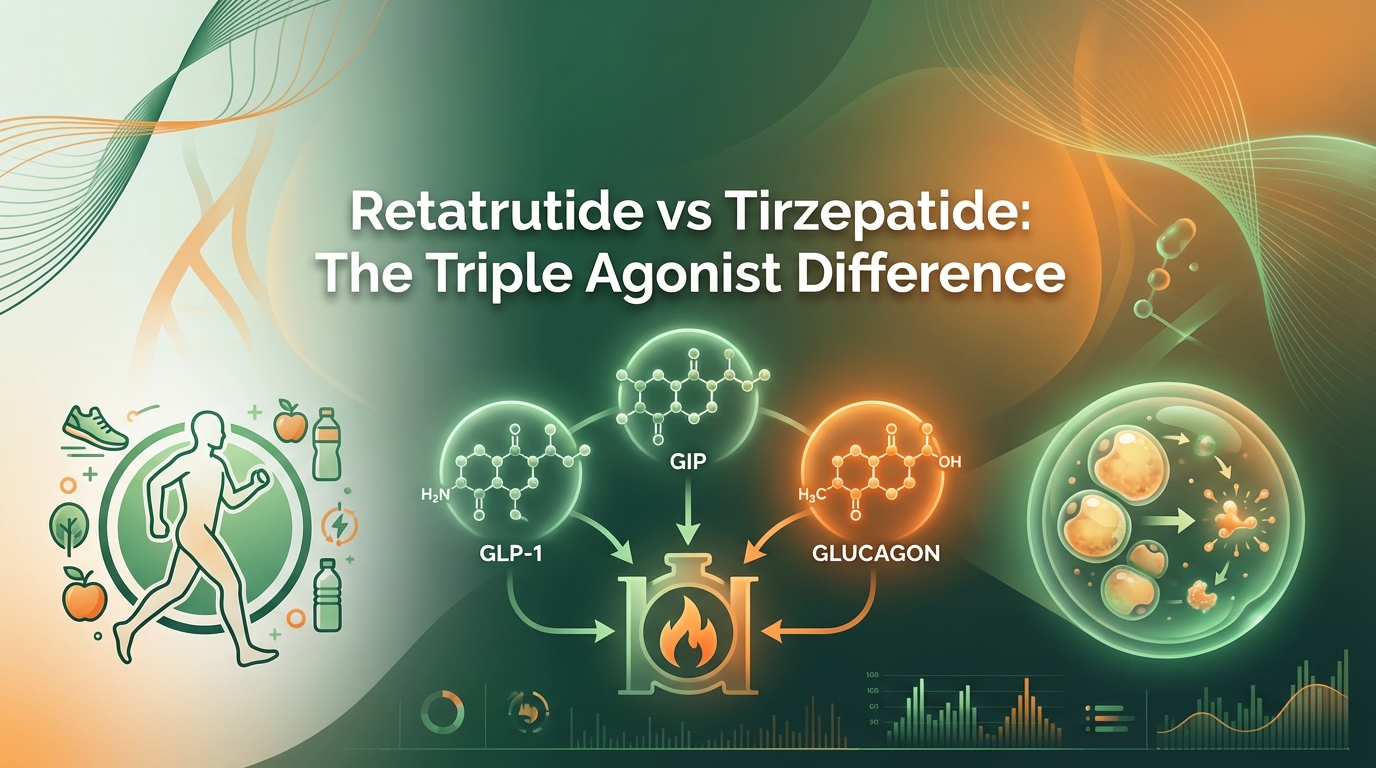
The next evolution involves triple agonists that add glucagon receptor activation to the GLP-1/GIP combination. Retatrutide represents this approach. Glucagon typically works opposite to insulin, raising blood sugar when levels drop too low. In the context of a triple agonist, glucagon activation increases energy expenditure and promotes fat burning without causing dangerous blood sugar swings.
Early phase 2 trials suggest retatrutide may produce weight loss exceeding 24% of body weight. This progression—from single to dual to triple receptor activation—reflects researchers identifying complementary hormonal pathways that together produce stronger effects than any single hormone alone.
The tradeoff involves complexity. More receptor targets mean more potential side effects and drug interactions. Each added mechanism creates additional variables in how individual patients respond. Someone who tolerates semaglutide well might experience different effects from tirzepatide, not because of the GLP-1 component but because their GIP receptors respond differently. Understanding this progression helps explain why switching molecules sometimes works when increasing the dose of a current medication does not.
Why Some Patients Don't Respond to Standard GLP-1 Treatment
Between 10-15% of patients taking semaglutide experience minimal weight loss, typically defined as losing less than 5% of body weight after six months at therapeutic doses. This non-response rate surprises many patients who hear impressive average results, but averages mask significant individual variation. Several biological and practical factors explain this outcome variability.
Inadequate dosing represents the most common issue. Many patients never reach the full maintenance dose of 2.4 mg weekly for semaglutide because side effects prompt their physicians to keep them at lower titration levels. A patient taking 1.0 mg weekly can't be classified as a true non-responder to the medication—they simply haven't received a therapeutic weight loss dose. Insurance barriers sometimes trap patients at diabetes-approved doses (1.0 mg) rather than obesity-approved doses (2.4 mg), creating apparent treatment failure.
Genetic variations in GLP-1 receptor expression and function likely account for some genuine non-responders. Research has identified polymorphisms in the GLP1R gene that affect receptor density and signaling strength. Someone with naturally lower receptor expression or impaired downstream signaling may need dramatically higher doses. Or they may respond better to a different molecular approach entirely, such as switching to a dual or triple agonist.
Compensatory metabolic adaptations can also blunt results. Some patients experience significant reductions in resting metabolic rate as they lose weight, sometimes exceeding the expected decrease from reduced body mass alone. If metabolic rate drops by 300 calories daily beyond what the weight loss would predict, the appetite suppression effects must overcome this additional deficit to continue producing weight loss.
Medication non-adherence, whether from cost barriers or side effect intolerance, obviously prevents results but often goes unreported in clinical settings. The troubleshooting sequence should follow this hierarchy: verify actual dosing and adherence, ensure sufficient treatment duration at maintenance dose, then consider switching receptor targets before concluding the patient is treatment-resistant.
Why Some Patients Don't Lose Weight on Semaglutide — and What Comes Next
Roughly 10–15% of patients prescribed semaglutide at therapeutic doses experience minimal or no clinically significant weight loss, as evidenced by STEP trial sub-analyses. The medical community often calls these individuals "non-responders," but that label misleads. It implies the drug simply failed. The reality is more layered — and more fixable.
The first checkpoint is pharmacokinetic, not pharmacological. Is the patient actually on the maximum tolerated dose? Many prescribers plateau patients at 1.0 mg of semaglutide due to GI side effects, never reaching the 2.4 mg dose approved specifically for obesity. That gap alone can account for an underwhelming result. Slower titration schedules — extending each dose step from four weeks to six or eight — often allow patients to reach full dosing with manageable nausea.
If dosing is confirmed adequate, the next question is molecular. Semaglutide activates only the GLP-1 receptor. Some patients carry GLP-1 receptor polymorphisms that reduce binding affinity, though large-scale pharmacogenomic data on this remains thin. For these individuals, switching to tirzepatide introduces a second mechanism: GIP receptor agonism. GIP independently stimulates insulin secretion and appears to influence fat metabolism through pathways that GLP-1 doesn't reach. In the SURMOUNT trials, tirzepatide produced mean weight loss of up to 22.5% at the highest dose, outperforming semaglutide's STEP trial results. This isn't just "more of the same." It's a fundamentally broader hormonal signal.
Beyond the molecule itself, lifestyle confounders deserve scrutiny. Chronic sleep deprivation (under six hours) elevates ghrelin and cortisol, both of which directly oppose GLP-1-mediated appetite suppression. High-dose alcohol intake impairs hepatic glucose regulation and adds caloric load the drug can't override. These aren't minor footnotes. They're load-bearing walls in the treatment plan.
A practical troubleshooting sequence looks like this: confirm dose adequacy → evaluate titration speed → consider molecular switch to dual agonism → audit sleep, alcohol, and protein intake → reassess at 16 weeks. Clinicians who skip straight from "semaglutide didn't work" to "surgery consult" are leaving at least two intermediate steps on the table.
Retatrutide and CagriSema: What the Next Generation Actually Does Differently
The phrase "next-generation GLP-1" gets thrown around loosely. It often just means "newer." But the two most significant molecules in late-stage development — retatrutide and CagriSema — represent genuinely distinct pharmacological strategies, not incremental upgrades.
Retatrutide is a triple agonist. It activates GLP-1, GIP, and glucagon receptors at the same time. The glucagon component is the critical differentiator. Glucagon is traditionally understood as a fasting hormone that raises blood sugar, which makes its inclusion in an obesity drug seem counterintuitive. But glucagon also drives hepatic lipid oxidation and increases resting energy expenditure. In phase 2 trials, retatrutide at the 12 mg dose produced a mean weight loss of 24.2% at 48 weeks — the highest figure ever recorded for a subcutaneous injectable in a controlled trial. The glucagon receptor activity essentially adds a thermogenic engine on top of the appetite suppression provided by GLP-1 and GIP signaling.
CagriSema takes a different architectural approach. Rather than cramming multiple receptor targets into one molecule, it combines two separate peptides: semaglutide and cagrilintide, a long-acting amylin analog. Amylin is co-secreted with insulin from pancreatic beta cells after meals. It slows gastric emptying, suppresses post-meal glucagon secretion, and acts on the area postrema in the brainstem to produce satiety through a pathway that is neuroanatomically separate from GLP-1 signaling. This matters for patients who experience diminishing appetite suppression over time on semaglutide alone — a phenomenon sometimes called "GLP-1 receptor tachyphylaxis," though that term remains debated.
Phase 2 data (published in The Lancet) showed CagriSema achieving approximately 15.6% mean weight loss at 32 weeks, with a notable finding: patients who'd previously plateaued on semaglutide monotherapy resumed losing weight after cagrilintide was added. The tolerability profile also appeared favorable, with lower rates of severe nausea compared to high-dose semaglutide alone.
For the stalled patient, the strategic takeaway is clear. Retatrutide adds metabolic burn. CagriSema adds a second satiety pathway. Neither is simply "stronger semaglutide."
The Sarcopenia Problem: Why Muscle Loss May Be the Defining Risk of Potent Incretin Therapy
As weight loss percentages climb into the 20%+ range with newer agonists, a quieter concern is gaining urgency among endocrinologists and sports medicine physicians: how much of that lost weight is muscle?
In the STEP 1 trial for semaglutide, approximately 40% of total weight lost was lean body mass. Tirzepatide's SURMOUNT data showed a similar ratio in body composition substudies. This isn't unique to GLP-1 drugs — any caloric deficit produces some lean mass loss. But the speed and magnitude of weight reduction with potent incretin therapy compresses a process that usually unfolds over years into months. The body's proteolytic machinery doesn't distinguish between unwanted fat and needed skeletal muscle when energy supply drops rapidly.
The clinical stakes are highest for patients over 50. Age-related sarcopenia is already progressing in this population. Layering aggressive pharmacological weight loss on top of it can push functional muscle mass below thresholds associated with falls and metabolic dysfunction. Dual-energy X-ray absorptiometry (DEXA) scans before and during treatment are the most reliable way to monitor this, yet they remain uncommon in obesity medicine practice.
Mitigation strategies center on two pillars: resistance training and protein intake. Current evidence supports a minimum of two structured resistance sessions per week, emphasizing compound movements that recruit large muscle groups. Protein targets should be set at 1.2–1.6 grams per kilogram of ideal body weight daily — a range that becomes genuinely difficult to hit when appetite is profoundly suppressed. This is where practical planning matters. Liquid protein sources, pre-planned meals, and protein-first eating strategies aren't optional lifestyle suggestions; they're medical countermeasures.
Some clinicians are exploring adjunctive peptide therapy — particularly growth hormone secretagogues like CJC-1295/Ipamorelin — to preserve lean mass during GLP-1 treatment. The mechanistic rationale exists: pulsatile GH release supports nitrogen retention and muscle protein synthesis. However, controlled trial data specifically examining this combination is essentially nonexistent. Patients considering this route should understand they're operating ahead of the evidence, not alongside it.
The broader point is structural. Prescribing a potent incretin agonist without a concurrent muscle preservation plan is an incomplete treatment protocol. The number on the scale isn't the only number that matters.
The Agonist Escalation Ladder: A Framework for Matching Molecule to Patient
Most clinical discussions treat GLP-1 prescribing as a one-shot decision. Patient is obese; patient gets Semaglutide. But the emerging pharmacology demands a more structured way of thinking—one that maps the intensity of receptor activation to the complexity of a patient's metabolic dysfunction.
Think of it as a three-rung ladder.
Rung 1: Single Agonism (GLP-1 only). Semaglutide and Liraglutide live here. They target one receptor, suppress appetite effectively, and produce average total body weight loss of roughly 14.9% over 68 weeks. For patients whose primary issue is overeating with mild insulin resistance, this rung often suffices. It's the entry point, not the ceiling.
Rung 2: Dual Agonism (GLP-1 + GIP). Tirzepatide occupies this space. By activating both GLP-1 and GIP receptors at the same time, it achieves roughly 20.9% weight loss in clinical trials. The GIP component appears to improve fat cell insulin sensitivity through a mechanism that GLP-1 alone can't replicate. Patients who plateau on single agonists—or who present with significant insulin resistance alongside obesity—are logical candidates for this rung.
Rung 3: Triple Agonism (GLP-1 + GIP + Glucagon). Retatrutide sits here, currently in Phase 3 trials. Adding the glucagon receptor does something neither of the lower rungs can: it directly increases energy expenditure by stimulating hepatic fat oxidation. Early data showed up to 24.2% body weight reduction at 48 weeks. This rung is built for the metabolically complex patient—think severe NAFLD layered with obesity and entrenched insulin resistance.
The critical insight is that these rungs aren't interchangeable lifestyle choices. Each additional receptor target introduces new benefit and new physiological stress. Glucagon activation, for instance, raises theoretical concerns about lean mass catabolism that single agonists largely avoid. Climbing the ladder without clinical justification isn't optimization. It's unnecessary risk.
No competitor framework currently maps it this plainly. But as these molecules move from trials to formularies, clinicians and patients alike will need a mental model for when escalation makes sense—and when staying put is the smarter move.
The "Berberine Is Nature's Ozempic" Claim: What the Data Actually Shows
Social media crowned Berberine as a natural GLP-1 alternative in 2023. The claim spread fast. The evidence did not keep pace.
Here's what Berberine actually does. It activates AMPK, an enzyme that improves glucose uptake in muscle cells and reduces hepatic glucose output, a pathway well-documented in metabolic research. This mechanism genuinely lowers fasting blood sugar—meta-analyses show reductions of approximately 0.5% in HbA1c. That's real. That's also not how GLP-1 agonists work.
Semaglutide binds directly to the GLP-1 receptor on pancreatic beta cells, triggering glucose-dependent insulin secretion. It slows gastric emptying at the same time and acts on hypothalamic appetite centers to reduce hunger signaling. Berberine does none of these things through incretin pathways. One animal study suggested Berberine might indirectly increase GLP-1 secretion from L-cells in the gut, but the magnitude was small and hasn't been replicated in controlled human trials.
The honest comparison: Berberine is a modest insulin sensitizer with a mechanism closer to Metformin than to any injectable GLP-1 agonist. Calling it "Nature's Ozempic" is like calling aspirin "Nature's chemotherapy" because both affect cell proliferation. Technically adjacent. Clinically misleading.
This matters because patients priced out of brand-name GLP-1s—where monthly costs can exceed $1,000 without insurance—deserve accurate information about what a $20 supplement can and can't do. Berberine may complement a metabolic protocol. It can't replace direct receptor agonism. Framing it otherwise risks delaying effective treatment for people who need it most.
Wrapping It Up
The landscape of GLP-1 therapy extends far beyond the Ozempic headlines dominating social media. Understanding the distinctions between single, dual, and triple agonists empowers patients to have more informed conversations with their healthcare providers. Semaglutide and Tirzepatide represent just the beginning of what incretin-based medicine can achieve.
For those experiencing plateaus or inadequate responses, the path forward isn't surrender—it's systematic troubleshooting. Dosage optimization, molecular switching, and addressing underlying factors like muscle loss or medication interactions can unlock results that initially seemed impossible. The emerging pipeline of CagriSema and Retatrutide offers hope for patients who need more potent options or struggle with tolerability at higher doses.
The "natural alternative" conversation requires equal sophistication. Berberine and other supplements may support metabolic health through complementary pathways, but they don't replicate pharmaceutical GLP-1 receptor binding. Honest evaluation of these options—acknowledging both their legitimate benefits and their limitations—serves patients better than exaggerated marketing claims.
Muscle preservation deserves equal attention to fat loss. The most aggressive weight reduction means little if it compromises functional strength and metabolic health. Strategic protein intake, resistance training, and potentially targeted peptide support should accompany any GLP-1 protocol.
Ready to explore if peptide therapy might be right for you? Take our free personalized protocol assessment to receive customized recommendations based on your specific health goals.
Medical Disclaimer: This article is for educational purposes only and does not constitute medical advice. GLP-1 agonists are prescription medications requiring physician supervision. Individual responses vary, and treatment decisions should be made in consultation with qualified healthcare providers.