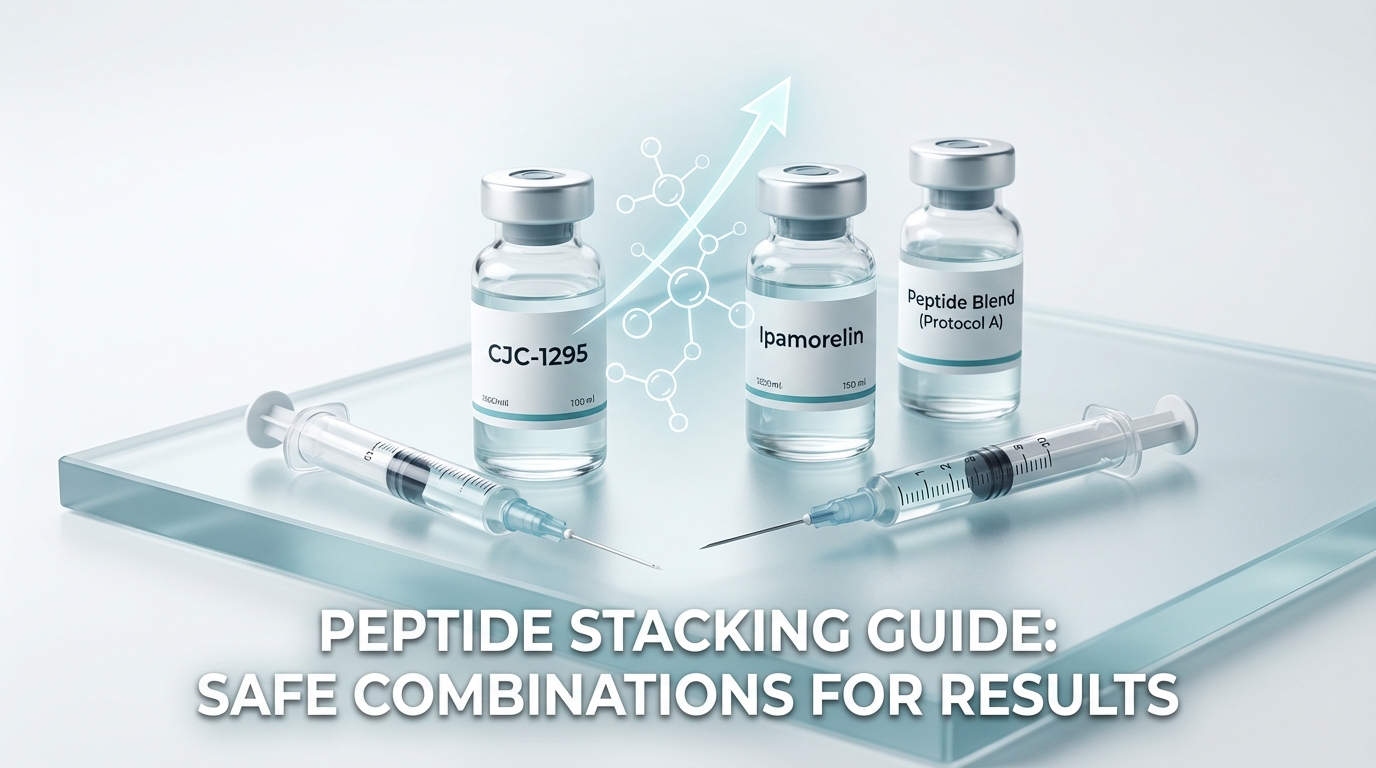
Peptide Stacking Guide: Safe Combinations for Results
Table of Contents
Peptide Stacking Guide: Safe Combinations for Maximum Results
The most compelling finding in recent peptide research isn't about any single compound—it's that certain combinations produce effects neither peptide achieves alone. When CJC-1295 and Ipamorelin are administered together, studies show growth hormone pulses increase by 300-500% compared to baseline, far exceeding what either peptide delivers independently. This same principle of amplification that makes stacking so appealing also introduces significant risks when done incorrectly.
Most information available online falls into two categories: overly cautious medical literature that dismisses combinations entirely, or forum advice that treats peptides like kitchen supplements to be mixed at will. Neither approach serves those seeking evidence-based optimization. The reality requires understanding receptor mechanics, competitive binding, and pharmacokinetic interactions—knowledge that separates safe, effective protocols from expensive mistakes or dangerous side effects.
This guide bridges that gap by explaining the biochemical mechanisms behind successful peptide combinations. It identifies which compounds genuinely complement each other versus those that compete for the same pathways. Readers will learn the specific interaction principles that govern "golden standard" stacks for recovery, metabolic enhancement, and growth hormone optimization, along with the critical demographic factors—age, gender, baseline health markers—that determine whether a particular combination makes medical sense. Most importantly, it provides the framework for having informed conversations with qualified healthcare providers rather than relying on trial and error with powerful biological compounds.
Understanding Peptide Stacking Mechanisms
Peptide stacking refers to the strategic combination of multiple therapeutic peptides to achieve complementary effects. Unlike simply taking higher doses of a single compound, proper stacking targets different biological pathways at the same time. This approach can produce enhanced outcomes while potentially requiring lower individual doses of each peptide.
The foundation of effective stacking lies in understanding receptor dynamics. Each peptide binds to specific receptors on cell surfaces. When two peptides target different receptor types, they work independently without competing for binding sites. For example, growth hormone releasing hormone (GHRH) analogs bind to GHRH receptors in the pituitary gland, while growth hormone releasing peptides (GHRPs) bind to specific ghrelin receptors. Using both types together increases growth hormone pulse amplitude and frequency beyond what either achieves alone.
Receptor saturation presents a critical limitation. Once all available receptors are occupied, adding more of the same peptide produces diminishing returns. This explains why doubling the dose of a single peptide rarely doubles results. The body's receptor population has finite capacity at any given time.
Pharmacokinetics—how the body absorbs, distributes, and eliminates compounds—also affects stacking outcomes. Peptides have varying half-lives ranging from minutes to several days. Short-acting peptides like Ipamorelin (half-life approximately 2 hours) clear the system quickly, while modified versions like CJC-1295 with DAC remain active for up to 8 days. Combining peptides with different kinetic profiles allows for both immediate and sustained effects. A short-acting peptide provides acute stimulation while a long-acting variant maintains baseline elevation.
Timing protocols become more complex with multiple peptides. Some combinations work best when administered together, creating a coordinated biological response. Others require staggered dosing to prevent competition for absorption sites or to align with natural circadian rhythms. Understanding these temporal relationships separates effective protocols from haphazard experimentation.
The "Golden Standard" Stacks: Evidence-Based Protocols
Certain peptide combinations have emerged as foundational protocols based on complementary mechanisms and documented outcomes. These represent starting points for understanding strategic combinations, though individual responses vary significantly.
The Growth Optimization Stack: CJC-1295 (No DAC) + Ipamorelin
This combination addresses growth hormone release through two distinct pathways. CJC-1295 without DAC (drug affinity complex) acts as a GHRH analog, amplifying the strength of growth hormone pulses. Ipamorelin functions as a GHRP, triggering the release of these pulses more frequently. Together, they create both stronger and more frequent growth hormone secretion episodes.
The practical protocol typically involves administering both peptides at the same time, usually before bed to align with natural nocturnal growth hormone peaks. Common dosing ranges from 100-200 mcg of each peptide per injection based on clinical tolerance studies. This stack gained popularity because both compounds have minimal impact on cortisol and prolactin, reducing unwanted hormonal side effects compared to older GHRPs.
The Tissue Repair Stack: BPC-157 + TB-500
BPC-157 and TB-500 (Thymosin Beta-4) target soft tissue healing through different mechanisms. BPC-157 promotes angiogenesis—the formation of new blood vessels—which improves nutrient delivery to damaged tissues. It also appears to modulate growth factor expression in healing areas. TB-500 works by upregulating actin, a protein essential for cell migration and tissue structure. This allows cells to move more effectively to injury sites.
Athletes and individuals recovering from injuries often use this combination for tendon, ligament, and muscle damage. Typical protocols involve 250-500 mcg of BPC-157 and 2-5 mg of TB-500 twice weekly. The compounds can be administered locally near injury sites or systemically via subcutaneous injection.
The Peptide Interaction Matrix: What Works, What Doesn't, and What Degrades in the Syringe
Most stacking guides stop at "these two peptides go well together." That's not enough. Understanding why certain combinations amplify results—and why others sabotage your protocol—requires a working knowledge of receptor competition, chemical stability, and timing.
Start with the concept of receptor saturation. Growth hormone secretagogue receptors (GHS-R1a) have a finite binding capacity. Flooding them with two GHRP-class peptides—say Ipamorelin and GHRP-6 at the same time—doesn't double the growth hormone pulse. It creates competitive inhibition at the same receptor site, which can actually blunt the response you're chasing. The smarter play is pairing peptides that hit different receptor classes. CJC-1295 (no DAC) activates the GHRH receptor to prime the pituitary, while Ipamorelin triggers GHS-R1a to release the pulse. One loads the gun. The other pulls the trigger. This is why the combination produces a GH pulse significantly greater than either peptide administered alone.
Now, the syringe question. Can you physically combine peptides in one injection? Sometimes. But "can" and "should" diverge quickly. Peptides are fragile chains of amino acids held together by weak bonds. When two reconstituted peptides share the same solution, pH mismatches and enzymatic cross-reactions can accelerate hydrolysis—the breaking of peptide bonds—within minutes. BPC-157 and TB-500 are commonly drawn into a single syringe for convenience. Limited practitioner reports suggest short-term co-mixing (injected immediately) may preserve bioactivity, but no published stability data confirms this remains true beyond a few minutes in solution. The safest practice? Reconstitute separately, draw separately, inject at different sites.
Know the hard "no" combinations. Stacking multiple melanocortin receptor agonists—PT-141 with Melanotan II, for example—compounds the risk of nausea, blood pressure spikes, and dangerous cardiovascular flushing. These aren't additive side effects. They're multiplicative. Similarly, combining long-acting GLP-1 agonists like semaglutide with aggressive appetite-suppressing agents can push caloric intake dangerously low, risking muscle catabolism and metabolic adaptation—the exact opposite of optimization.
The takeaway: stack across pathways, not within them. And never assume chemical compatibility without data.
Demographics and Personalization: Why Your Stack Should Reflect Your Biology
A 32-year-old male athlete and a 58-year-old woman recovering from a rotator cuff injury have almost nothing in common physiologically. Yet most peptide stacking guides hand them the same protocol. This is a critical failure point in the current conversation around peptide therapy.
Gender creates meaningful differences. Women have naturally higher baseline GH secretion than men during reproductive years, largely driven by estrogen's amplification of pituitary responsiveness. This means a standard Ipamorelin dose (200–300 mcg) may produce an exaggerated GH spike in premenopausal women, increasing the risk of water retention, joint pain, and insulin resistance. Dose reduction of 20–30% is a reasonable clinical starting point, adjusted based on IGF-1 monitoring. Menstrual cycle timing also matters. The luteal phase (post-ovulation) is associated with progesterone-driven fluid shifts that can worsen edema-related side effects from GH-stimulating stacks. Some practitioners recommend confining aggressive GH protocols to the follicular phase, though controlled studies remain scarce.
For men, the primary flag is prostate health. GH and IGF-1 are growth signals. They don't distinguish between muscle tissue and prostatic tissue. Men over 40 using GH secretagogue stacks should monitor PSA levels at baseline and every 8–12 weeks based on prostate health guidelines. This isn't optional—it's a basic safety gate.
Age reshapes receptor sensitivity. The somatotroph cells in the pituitary become less responsive with age. A dose that produces strong GH release in a 30-year-old may generate a muted response in a 60-year-old—but paradoxically, the side effects (insulin disruption, carpal tunnel symptoms) can hit harder in older adults due to reduced metabolic clearance. The "start low, go slow" principle becomes non-negotiable past age 50. Begin at 50–60% of standard dosing. Titrate upward over 4–6 weeks only after confirming fasting glucose, fasting insulin, and IGF-1 remain within safe ranges.
Personalization isn't a luxury. It's the difference between a protocol that works and one that causes harm. Any provider offering a one-size-fits-all peptide stack should raise immediate skepticism.
Safety Protocols and Monitoring: The Biomarkers That Tell You the Truth
Peptides feel safe because they're naturally occurring signaling molecules. That perception creates a dangerous blind spot. Stacking amplifies both desired effects and metabolic stress—and without objective data, you're guessing about which one is winning.
Before starting any multi-peptide protocol, establish baseline bloodwork. The minimum panel should include: IGF-1 (the downstream marker of GH activity), fasting insulin, fasting glucose, HbA1c, high-sensitivity C-reactive protein (hs-CRP), a complete metabolic panel covering liver enzymes (AST, ALT), and kidney function markers (BUN, creatinine). These aren't vanity labs. GH-stimulating stacks directly impair insulin sensitivity over time—sometimes within weeks. If fasting insulin climbs above 10 µIU/mL or fasting glucose exceeds 100 mg/dL during a protocol, the stack needs immediate reassessment.
IGF-1 is your primary efficacy and safety compass. Therapeutic optimization typically targets IGF-1 levels in the upper quartile of the age-adjusted reference range. Pushing beyond that—into supraphysiological territory—doesn't produce proportionally better results. It does, however, increase the theoretical risk of abnormal cell proliferation. Recheck IGF-1 at 4 weeks and 8 weeks after initiating a GH secretagogue stack. Stable readings within range mean the protocol is working as intended. Rising values beyond the upper limit signal that dosing has exceeded what the body can safely use.
Inflammation markers catch problems that "feel fine" misses. BPC-157 and TB-500 are valued for their tissue repair properties, but they achieve this partly through modulation of inflammatory pathways and vascular endothelial growth—the formation of new blood vessels. In theory, this is beneficial. In practice, anyone with undiagnosed malignancy shouldn't be promoting angiogenesis. A baseline hs-CRP and periodic monitoring helps flag unexplained inflammatory shifts that warrant further investigation.
Side effect management is equally concrete. Water retention from GH stacks responds to mild sodium restriction and timed carbohydrate intake around activity. Injection site reactions—redness, itching, small nodules—typically resolve with proper site rotation across at least four locations (abdomen, outer thigh, upper glute, tricep area). Persistent nodules suggest a reconstitution or purity issue, not a normal response.
Track the numbers. Adjust based on data, not feel. That's the line between optimization and recklessness.
The Receptor Budget Model: Why Stacking Demands Subtraction, Not Addition
Most peptide guides treat stacking like a shopping cart—toss in more compounds, expect more results. This fundamentally misunderstands how peptide receptors work. A more accurate framework is what clinical practitioners increasingly call the "receptor budget."
Here's the concept. Every receptor population in the body has a finite capacity within a given timeframe. Growth hormone secretagogue receptors (GHS-R1a), for example, can only fire so many times before they temporarily undergo internalization. Think of this as a daily spending limit. Each peptide in a stack draws from that same budget. Adding a third or fourth compound doesn't expand the budget. It just divides the spending thinner.
This is why the CJC-1295/Ipamorelin combination works so well on paper—and in practice. These two peptides don't compete for the same receptor. CJC-1295 acts on growth hormone-releasing hormone (GHRH) receptors, while Ipamorelin targets ghrelin receptors. They access separate budgets. The result is a stronger growth hormone pulse than either peptide produces alone, precisely because there's no receptor-level competition.
Now contrast this with stacking Ipamorelin alongside GHRP-6. Both target the same receptor pathway. They're pulling from the same account. Beyond a certain dose threshold, additional stimulation doesn't produce a proportional response. It just accelerates receptor downregulation, meaning diminishing returns arrive faster—and side effects like elevated cortisol or prolactin may increase without corresponding benefit.
The practical rule: before adding any peptide to a stack, identify its primary receptor target. If two compounds share a target, one likely needs to go. Effective stacking fills different receptor budgets, not the same one twice.
The 72-Hour Biomarker Checkpoint Most Protocols Skip
Here's a contrarian position that challenges standard stacking advice: the first blood test shouldn't happen at the commonly recommended 4–6 week mark. It should happen within 72 hours of starting a new stack.
Why? Because acute inflammatory markers and fasting insulin respond to exogenous peptides far faster than most practitioners acknowledge. A 2019 pharmacokinetic analysis demonstrated that IGF-1 levels can shift measurably within 48–72 hours of initiating growth hormone secretagogue therapy. Waiting a full month means flying blind during the period when adverse interactions are most likely to surface and easiest to correct.
The recommended 72-hour checkpoint panel includes fasting insulin, high-sensitivity C-reactive protein (hs-CRP), and IGF-1. These three markers together form a rapid-response dashboard. Elevated fasting insulin within 72 hours may signal that a metabolic stack involving GLP-1 agonists alongside growth hormone peptides is creating conflicting glucose disposal signals. A spike in hs-CRP could indicate that the immune-modulating effects of compounds like BPC-157 or TB-500 are triggering an unintended inflammatory response rather than resolving one.
This early checkpoint doesn't replace detailed bloodwork at 30 and 60 days. It supplements it. Think of it as a smoke detector rather than a full home inspection. Most competitor guides recommend monitoring only after the stack is well-established. By then, receptor desensitization or metabolic disruption may already be entrenched and harder to reverse. Early data points allow for dose adjustments—or compound removal—before small problems become stubborn ones.
Building Your Protocol with a Provider
Peptide stacking represents a sophisticated approach to optimizing physiological function, but success depends entirely on understanding receptor interactions, pharmacokinetics, and individual response patterns. The combinations outlined in this guide—from growth optimization pairs like CJC-1295 with Ipamorelin to recovery protocols combining BPC-157 and TB-500—demonstrate how complementary mechanisms can produce superior outcomes compared to single-peptide approaches.
However, the difference between effective therapy and unnecessary risk lies in proper medical oversight. Baseline biomarker testing, staged implementation protocols, and ongoing monitoring aren't optional safety measures—they're fundamental requirements for responsible peptide use. Age, gender, existing health conditions, and medication interactions all influence which combinations are appropriate and at what dosages.
The interaction matrix and contraindication warnings presented here should serve as educational frameworks, not prescriptive instructions. Working with a knowledgeable healthcare provider allows for personalized protocol design that accounts for your unique physiology, realistic adjustment based on measured results, and intervention if adverse effects develop.
Medical Disclaimer: This guide is for educational purposes only and doesn't constitute medical advice. Peptide therapy requires prescription and supervision by a licensed healthcare provider. Don't attempt to design or implement stacking protocols without professional medical guidance.
Ready to explore if peptide therapy might be right for you? Take our free personalized protocol assessment to receive customized recommendations based on your specific health goals.