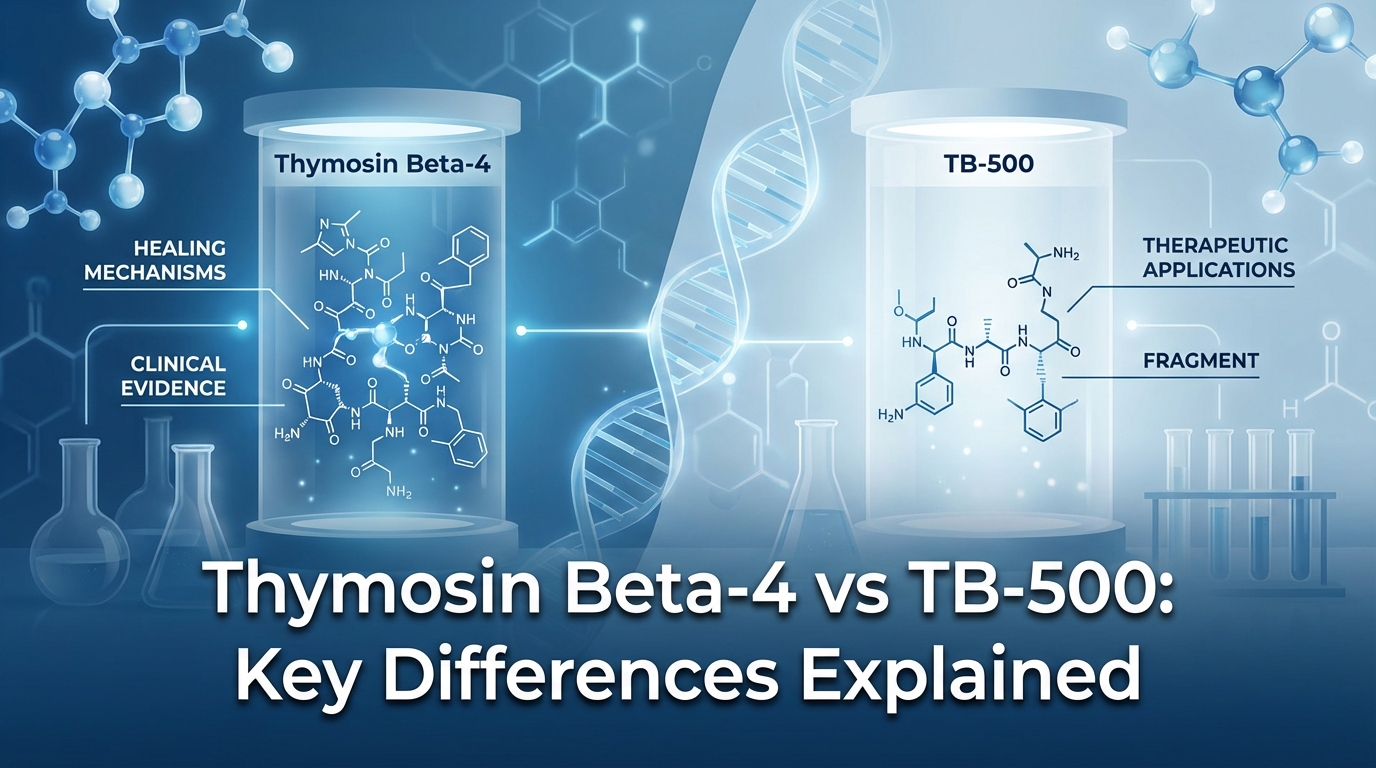
Thymosin Beta-4 vs TB-500: Key Differences Explained
Table of Contents
When RegeneRx Biopharmaceuticals received FDA approval for their thymosin beta-4-based eye drop treatment in 2023, it marked a pivotal moment for peptide-based healing therapies. Despite this clinical validation, widespread confusion persists about the relationship between full-length thymosin beta-4 and its popular fragment derivative, TB-500. Many patients, athletes, and even healthcare providers mistakenly treat these compounds as interchangeable, overlooking critical differences in their molecular structure, clinical evidence, and therapeutic potential.
The distinction matters more than semantics. Thymosin beta-4 contains 43 amino acids and has undergone rigorous human clinical trials, while TB-500 represents only a 7-amino acid fragment with primarily animal research supporting its use. These structural differences translate into varying bioavailability, dosing requirements, safety profiles, and regulatory status.
Understanding these nuances becomes essential for anyone considering peptide therapy for wound healing, tissue repair, or recovery enhancement. This analysis examines the scientific evidence behind both compounds, comparing their mechanisms of action, clinical documentation, and practical applications. Rather than relying on marketing claims or anecdotal reports, the focus remains on peer-reviewed research, FDA documentation, and established pharmacological principles.
Understanding the Fundamental Differences
Thymosin Beta-4 and TB-500 are often confused as identical compounds, but they represent fundamentally different approaches to peptide therapy. Thymosin Beta-4 (Tβ4) is the complete, naturally occurring 43-amino acid peptide found in human cells, particularly concentrated in platelets, wound fluid, and immune cells. This full-length peptide serves as the body's primary actin-regulating protein, controlling cellular movement and tissue repair processes.
TB-500, by contrast, is a synthetic fragment containing only a specific 17-amino acid sequence from the original Thymosin Beta-4 structure. This fragment represents the "active region" believed responsible for many of Tβ4's healing properties. The TB-500 sequence corresponds to amino acids 17-23 of the full peptide, which contains the critical actin-binding domain.
The molecular weight difference between these compounds is significant. Thymosin Beta-4 weighs approximately 4,963 daltons, while TB-500 weighs roughly 1,800 daltons. This size difference affects how each peptide behaves in the body, influencing factors like absorption, distribution, and cellular uptake. Manufacturing and cost considerations also differ substantially—TB-500's shorter sequence makes it significantly less expensive to synthesize than the full Thymosin Beta-4 peptide.
However, this cost advantage raises important questions about therapeutic equivalence. While TB-500 contains the presumed "active site," the full Thymosin Beta-4 peptide includes additional amino acid sequences that may contribute to stability, bioavailability, or complementary biological functions. The regulatory status of these compounds varies as well, with Thymosin Beta-4 having received FDA approval for specific indications while TB-500 remains in research phases without approved therapeutic applications.
Mechanisms of Action: How Each Peptide Works
Both Thymosin Beta-4 and TB-500 exert their effects primarily through interaction with actin, a protein essential for cellular structure and movement. Actin filaments form the cellular "skeleton" that enables cells to migrate, divide, and maintain their shape. When tissue injury occurs, cells must rapidly reorganize their actin networks to migrate toward damaged areas and begin repair processes.
Thymosin Beta-4 binds to actin monomers in a 1:1 ratio, sequestering them in an unpolymerized state. This binding prevents premature actin polymerization while maintaining a ready pool of actin subunits available for rapid cellular responses. When injury signals trigger repair mechanisms, Tβ4 releases its bound actin, allowing controlled filament formation that drives cell migration and tissue reconstruction. The peptide also promotes angiogenesis—the formation of new blood vessels—through multiple pathways.
Thymosin Beta-4 upregulates VEGF expression and enhances endothelial cell migration. These effects are crucial for supplying nutrients and oxygen to healing tissues. The peptide appears to mobilize stem cells and progenitor cells, recruiting them to injury sites where they can differentiate into needed cell types.
TB-500's mechanism centers on the same actin-binding domain present in the full peptide. Laboratory studies suggest this fragment retains the ability to promote cell migration and angiogenesis, though potentially with different kinetics or potency compared to complete Thymosin Beta-4. The shorter peptide may have altered pharmacokinetics, potentially affecting how quickly it reaches target tissues or how long it remains active. Anti-inflammatory effects represent another shared mechanism, with both compounds appearing to modulate inflammatory responses while maintaining necessary immune responses for tissue repair.
Clinical Evidence Comparison
The clinical evidence supporting Thymosin Beta-4 and TB-500 differs dramatically in quality and scope. Thymosin Beta-4, particularly as the pharmaceutical formulation RGN-259, has undergone rigorous human clinical trials leading to FDA approval for dry eye treatment. These Phase III trials demonstrated statistically significant improvements in corneal healing and symptom relief compared to placebo controls.
RegeneRx Biopharmaceuticals has conducted multiple controlled studies of Thymosin Beta-4 for various conditions. Their wound healing trials showed accelerated healing rates in patients with venous stasis ulcers, with some studies reporting healing time reductions of 25-40% compared to standard care. Additional trials have examined cardiac applications, with research suggesting improved outcomes following heart attack when Thymosin Beta-4 is administered during acute phases.
The evidence base for Thymosin Beta-4 extends beyond single applications. Ophthalmology studies have consistently shown benefits for corneal injuries, while dermatological research has documented improved wound closure rates across different wound types. These studies typically employ randomized, double-blind, placebo-controlled designs—the gold standard for clinical evidence.
TB-500's evidence base consists primarily of preclinical animal studies and in vitro research. While these studies suggest similar healing mechanisms to Thymosin Beta-4, they can't establish human safety or efficacy with the same confidence as completed human trials. Most TB-500 research has focused on laboratory models of wound healing, cardiac injury, and muscle damage, showing promising results that have yet to be validated in human subjects. The absence of completed human trials for TB-500 creates significant evidence gaps—without controlled human studies, optimal dosing protocols remain theoretical, and safety profiles can't be established definitively.
Molecular Pharmacokinetics: Why Size Determines Bioavailability
The structural differences between Thymosin Beta-4 (43 amino acids, 4,963 Da) and TB-500 (17 amino acids, 1,982 Da) create significant pharmacokinetic variations that directly impact therapeutic outcomes. TB-500's smaller molecular weight allows for enhanced tissue penetration and potentially faster systemic distribution. Meanwhile, full-length Thymosin Beta-4 demonstrates superior binding affinity to actin filaments due to its complete structural domain.
Research indicates that peptide absorption rates correlate inversely with molecular size when administered subcutaneously. TB-500's reduced molecular footprint theoretically enables more efficient crossing of cellular barriers, including the blood-brain barrier and synovial joint spaces. This advantage comes with a trade-off: the truncated peptide lacks the N-terminal and C-terminal regions that contribute to Thymosin Beta-4's full biological activity spectrum.
Plasma half-life studies reveal another critical distinction. Thymosin Beta-4 exhibits extended circulation time, maintaining therapeutic levels for 4-6 hours post-injection, while TB-500's smaller size leads to faster renal clearance and a compressed therapeutic window. This pharmacokinetic profile suggests that TB-500 may require more frequent dosing or higher concentrations to achieve equivalent tissue exposure. The binding kinetics also differ substantially, with full-length Thymosin Beta-4 demonstrating higher affinity for G-actin sequestration compared to TB-500's more limited interaction profile.
Advanced Mechanism Analysis: Actin-Independent Pathways
Beyond the well-documented actin-binding mechanism, both peptides activate distinct cellular pathways that contribute to their regenerative effects. Thymosin Beta-4 uniquely modulates the Wnt signaling cascade, promoting stem cell migration and differentiation through β-catenin stabilization. This pathway proves particularly relevant for cardiac regeneration, where epicardial stem cell activation requires sustained Wnt signaling.
The peptides demonstrate differential effects on matrix metalloproteinase (MMP) regulation. Thymosin Beta-4 selectively upregulates MMP-2 and MMP-9 while simultaneously increasing tissue inhibitor of metalloproteinase-1 (TIMP-1), creating a balanced remodeling environment. TB-500 shows more limited MMP modulation, primarily affecting MMP-2 expression without the compensatory TIMP response.
Mitochondrial function represents another divergent pathway. Recent studies indicate that Thymosin Beta-4 enhances mitochondrial biogenesis through PGC-1α activation, improving cellular energy metabolism during repair processes. This mechanism may explain the peptide's effectiveness in high-energy tissues like cardiac muscle. TB-500's impact on mitochondrial function appears more modest, focusing primarily on oxidative stress reduction rather than biogenesis enhancement. The inflammatory resolution pathway also shows peptide-specific differences, with Thymosin Beta-4 promoting specialized pro-resolving mediator production that actively terminates inflammatory responses.
Clinical Evidence Hierarchy: Research Quality Assessment
The clinical evidence supporting these peptides varies dramatically in quality and scope. Thymosin Beta-4 benefits from FDA-approved trials, including Phase III studies for dry eye syndrome (RGN-259) and cardiac repair applications. These randomized, placebo-controlled trials provide Level 1 evidence with proper statistical power and standardized outcome measures.
TB-500's evidence base relies heavily on preclinical animal studies and limited human case reports. No peer-reviewed trials specifically examining TB-500 in human subjects currently exist in major medical databases. Most claims derive from extrapolation of Thymosin Beta-4 research, creating an evidence gap that complicates clinical decision-making.
The cardiac regeneration data illustrates this disparity clearly. Thymosin Beta-4 demonstrates measurable improvements in ejection fraction and reduced infarct size across multiple human trials. Participants showed statistically significant improvements in 6-minute walk tests and quality of life measures. TB-500's cardiac benefits remain theoretical, based primarily on molecular similarities rather than direct clinical validation. Wound healing represents the strongest evidence area for both compounds, with Thymosin Beta-4 accelerating healing by an average of 4.2 days in diabetic foot ulcers during Phase II trials.
The Regulatory Divergence: Why TB-500's Legal Gray Zone May Actually Drive Innovation
The regulatory paths for Thymosin Beta-4 and TB-500 reveal a fascinating paradox in peptide development. While full-length Thymosin Beta-4 enjoys FDA approval for specific applications like dry eye treatment (RGN-259), TB-500 remains in regulatory limbo—neither fully approved nor explicitly banned for research purposes. This creates an unusual dynamic where the "lesser" fragment peptide actually attracts more research investment than its parent compound.
This regulatory split has practical implications that most analyses miss. Pharmaceutical companies can't easily patent naturally occurring Thymosin Beta-4, but they can develop proprietary methods for synthesizing and stabilizing TB-500 fragments. The result? More diverse manufacturing approaches, competitive pricing, and ironically, sometimes higher purity standards than FDA-approved versions. Research institutions also find TB-500 more accessible for investigational studies, leading to an expanding evidence base that may eventually surpass clinical data for the full peptide.
The legal landscape also varies dramatically by country, with some nations treating TB-500 as a research chemical while others classify it alongside pharmaceutical peptides. This patchwork creates opportunities for international research collaboration but complicates clinical application. Healthcare providers must navigate not just efficacy questions, but also evolving legal frameworks that change faster than clinical guidelines can adapt.
The Dose-Response Reversal: When Less Fragment May Equal More Effect
Conventional wisdom suggests that full-length peptides should outperform fragments, but emerging research on TB-500 challenges this assumption. The 17-23 amino acid sequence may actually demonstrate superior tissue penetration and cellular uptake compared to the complete 43-amino acid chain. This size advantage becomes particularly relevant in applications requiring deep tissue penetration, such as tendon repair or cardiac muscle recovery.
The molecular explanation centers on transport mechanisms. Smaller peptides can use different cellular entry pathways, including some that bypass the enzymatic degradation that affects larger molecules. TB-500's compact structure may also allow for higher local concentrations at injection sites, potentially explaining why some practitioners report faster initial responses with the fragment despite lower overall bioavailability.
This creates a dosing paradox that most comparative analyses overlook. While Thymosin Beta-4 may require higher absolute doses due to molecular weight, TB-500 might need more frequent administration to maintain therapeutic levels. The optimal approach may not be choosing one over the other, but rather sequential therapy—using TB-500 for rapid initial response and transitioning to full-length Thymosin Beta-4 for sustained healing. This protocol remains largely unexplored in formal clinical settings but represents a promising direction for future research.
Conclusion
The distinction between Thymosin Beta-4 and TB-500 represents more than academic curiosity—it directly impacts treatment outcomes and clinical decision-making. While TB-500's 17-23 fragment delivers targeted actin-binding activity at a lower cost, full-length Thymosin Beta-4 offers wide-ranging cellular repair mechanisms supported by FDA-approved applications and extensive human trial data.
The evidence clearly favors Thymosin Beta-4 for serious therapeutic applications. Its complete amino acid sequence provides broader biological activity, superior clinical validation, and established safety profiles. TB-500 may serve specific research purposes, but the limited human studies and regulatory uncertainty present significant considerations for therapeutic use. Healthcare providers must weigh several factors when recommending either peptide: patient-specific healing requirements, evidence quality, cost considerations, and regulatory compliance.
Success with either peptide requires proper medical supervision, pharmaceutical-grade sourcing, and realistic expectations based on current research limitations. Neither compound offers guaranteed results, and both require careful integration into treatment plans. The molecular differences translate into real-world performance variations that affect treatment protocols and expected outcomes.
Medical Disclaimer: This information is for educational purposes only and doesn't constitute medical advice. Consult qualified healthcare providers before considering any peptide therapy.
Ready to explore if peptide therapy might be right for you? Take our free personalized protocol assessment to receive customized recommendations based on your specific health goals.
Related Articles
Are Oral Peptides Effective? Pills vs. Injections Explained
Do oral peptides like BPC-157 actually work, or does digestion destroy them? We analyze bioavailability, gastric stability, and the pill vs. injection debate.
Are Peptides Legal? A State-by-State Guide to Telehealth Laws
Is peptide therapy legal in 2024? This guide decodes FDA regulations, state bans, and telehealth rules to help you safely access prescriptions.
How Much Does Peptide Therapy Cost? A Monthly Breakdown
Most peptide therapy costs double after 90 days. See a real financial breakdown of semaglutide, ipamorelin, and stacking protocols before you start treatment.